The Last Dark Protocol

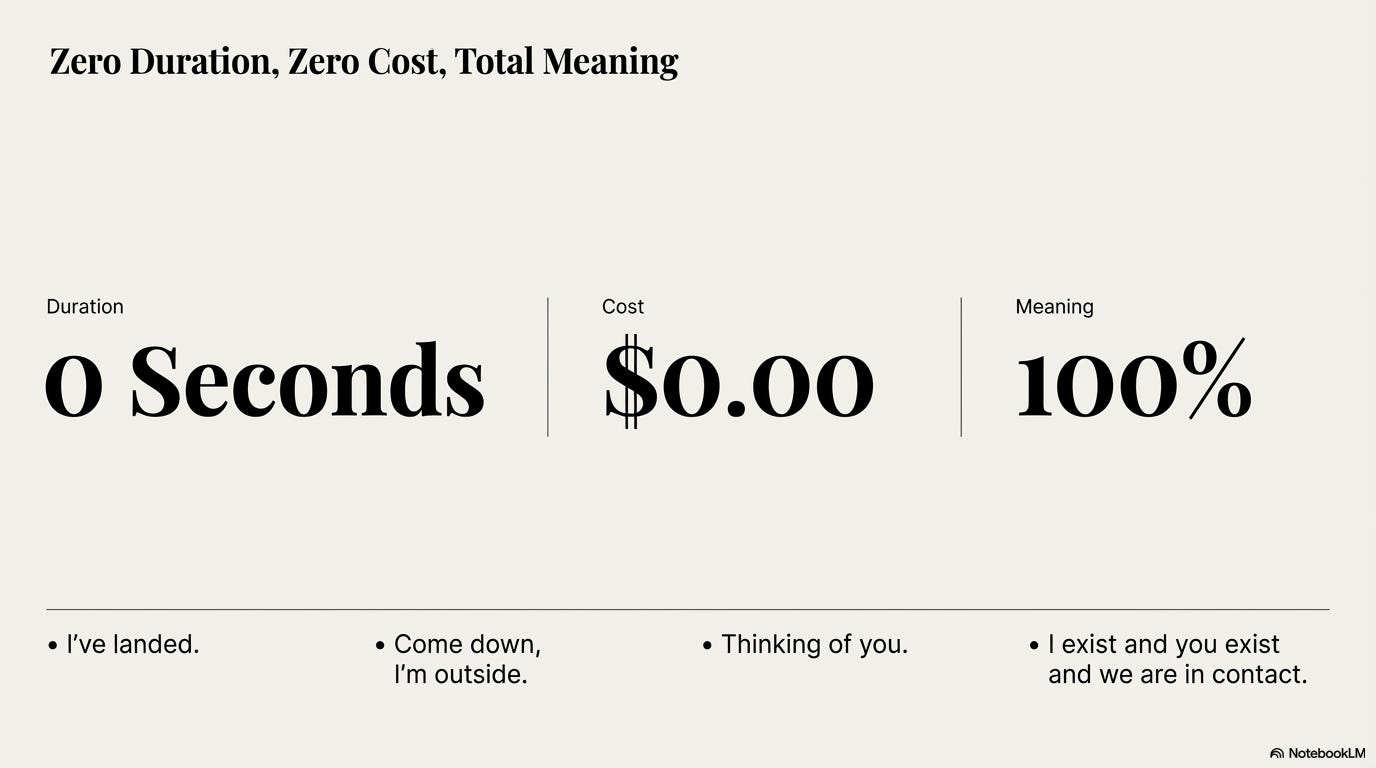
One ring, or a couple of rings, and hang up. No charge. Only signal.
It had a full vocabulary. "I've landed." "Come down, I'm outside." "Thinking of you." Sometimes just: I exist and you exist and we are in contact.
We did this for about fifteen years.
Then, we spent the next decade building apps to solve for trust, attention, and meaning in communication. The missed call had already solved all three. It just didn't have a product manager.
That last line was a joke. I've been reconsidering it. The product manager didn't arrive too late and miss an opportunity. The product manager arrived and ended it. Those are different stories.
Every message you send today passes through infrastructure that is trying to understand it. Not the words. The pattern. Response latency. Frequency. Who initiates. Who goes quiet. The missed call was the last widely-used communication act where the meaning was stored in exactly two places: the memory of the person who rang, and the memory of the person who heard it. The infrastructure had the timestamp. It had nothing else.
This matters more than it sounds. To understand why, we have to start with what the missed call actually was, which the nostalgia framing tends to obscure.
It was a convention. Nobody designed it, nobody documented it, and nobody owned it, but it acquired shared meaning through use alone. This is different from a designed system, which is specified, deployed, and maintained by its owners. The missed call crystallised from the edges. It spread because it solved a shared problem. It persisted because the community that used it maintained it collectively, with no authority required to adopt it and no centre that could be switched off.
It grew in the gap between what the billing system charged for and what people needed to say. Constraint produced elegance. Not because constraint always produces elegance — it doesn't — but because this particular constraint was shared. The prepaid condition was common. The need to communicate across it was common. The solution, once found, spread with the speed of any idea that travels by word of mouth through a network of people who all have the same problem.
This is how the most durable communication innovations tend to arrive: Discovered, in practice, by people under pressure, then ratified by the community that adopts them. The missed call had no launch event, no version number, no terms of service, and no off switch. It also had, at its peak, hundreds of millions of users across South Asia, Africa, and Latin America. There is arguably no communication practice in living memory with a comparable ratio of infrastructure to users — at least not one that spread as fast, in as many places, with as little.
A single ring, perhaps a couple, and then silence. The person who got the call looks at the screen. A name or number. And then an interpretation. That interpretation was not contained in the ring. The ring was a pointer. The payload was stored somewhere else entirely: in the accumulated context of the relationship.
Most models of communication assume the channel carries meaning. The missed call defeated this. The ring said: retrieve what you know about this person, this time of day, this week in our lives, and tell me what I'm being asked. The channel was almost incidental. What did the work was the shared memory of two people.
Which meant the semantic content — one ring versus two rings versus three rings — existed in exactly two places: the memory of the sender and the memory of the receiver. No server held it. No log captured it. You could subpoena the telco records and learn that a call of duration zero was placed at 14:32. You could map the relationship from the frequency of those calls. You could not learn what any of them meant. The meaning was encrypted by the relationship itself, recoverable by no one else.
That is not a limitation. That is a property that almost no communication medium has retained since.
The household codebook, two rings for this, one ring for that, two missed calls only in emergencies, was a private language in the strict sense. Not private as in confidential, but private as in belonging to a specific community of two or five or ten people, with no purchase outside it. The same ring that meant "I'm outside, come down" in your household meant nothing to the family next door. There was no dictionary. There could not be one. The code was the relationship, and the relationship was not transferable.
Linguists call this deixis: communication that only resolves if you already hold the context. "I'll be there" means nothing without a shared understanding of what "there" refers to. The missed call was pure deixis, a gesture that worked only if you held the right key. And the key was not a password. It was the history of two people.
There is a social dimension here that tends to get lost. Erving Goffman wrote about what he called civil inattention: the managed art of acknowledging someone without engaging them, a nod on a busy street that says I see you without asking anything in return. It is one of the small courtesies that make shared space bearable, and it works because it respects the other person's frame rather than rupturing it. The missed call was civil inattention across distance. It declared presence without demanding response. It arrived and left without asking you to stop what you were doing.
Compare this to a notification, which is engineered to rupture. It demands foreground. It is designed to interrupt. The missed call was the only communication medium in the modern era that was structurally incapable of this, not by design but by accident of architecture. It ended before you could answer. Attention was never on offer.
In India, the missed call did not emerge from clever people finding a workaround. It emerged from hundreds of millions of people navigating a daily arithmetic of communication costs that had no equivalent in the developed world. Prepaid balance was not a minor inconvenience. It was a binding constraint on social life. The decision to call — to actually connect and speak — was a small financial act, and on a prepaid plan with limited credit, small financial acts accumulate.
The missed call resolved this without either party spending anything. But it did more than that. The act of not spending was itself communicative. "I rang but did not charge you" carried a signal of consideration, of awareness of the other person's constraint, of solidarity inside shared scarcity. The form of the act carried social meaning the content of a full call could not have reproduced. You cannot say "I am thinking about your prepaid balance" in a message. You can demonstrate it by the form of your signal.
Marcel Mauss argued that the gift creates social bonds precisely because it is not equivalent exchange; it generates obligation through asymmetry rather than transaction. The missed call had exactly this structure: generating a social debt discharged through response rather than payment. You did not owe them money. You owed them a response, on your own time. When missed call marketing turned this into a conversion mechanism — "give us a missed call to subscribe" — the logic collapsed immediately. Commodification, as Lewis Hyde observed, destroys the gift's nature entirely. The ring persisted. The meaning did not.
Communities under scarcity tend to develop richer informal conventions than communities of abundance, for the straightforward reason that scarcity increases the incentive for compression. When communication is cheap, you over-communicate. When it is scarce, you compress. The missed call is the most extreme version of this compression: a message with zero content and non-zero meaning, achieving an efficiency that no designed system has matched.
What cheap data bought us was volume. What it cost us was the ability to decide what not to say!
Platforms arrived and did what platforms do: they sought to make legible what had previously been opaque. Not out of spite for the informal conventions they encountered, but because legibility is the only mode available to a platform. You cannot run a business on opacity. You cannot monetise a commons. You cannot extract value from meaning that lives entirely inside a relationship and has no representation anywhere in your infrastructure.
The telco missed call record was a ghost: a zero-duration timestamp with no semantic payload. Nothing there to mine. This was the defining property of the missed call as a medium, and it was, from a platform perspective, an absence, a failure, a problem to be solved.
The convention worked because it was illegible to the infrastructure. The moment the infrastructure could read it, the defining property was gone. Legibility and the missed call were incompatible. The platform did not destroy it deliberately. It destroyed it the way a bright light destroys a dark room: not through malice, but through the impossibility of coexistence.
James Scott spent a career documenting what happens when centralising institutions encounter informal systems they cannot parse. The institution does not adapt to the complexity it finds. It simplifies what it finds until the complexity is gone, then operates on the simplified version. The local knowledge is lost. The system that depended on that knowledge degrades. The institution calls this modernisation.
The platform called it a feature launch.
There is a commons argument here as well, and it runs a little differently.
Elinor Ostrom's life's work was demonstrating that communities manage shared resources sustainably — against the standard assumption that commons inevitably collapse under the weight of individual self-interest. Her evidence was that communities frequently outperform markets and states precisely because they hold local knowledge that neither market nor state can access, and because the social costs of defection are visible to everyone involved.
The missed call was a cognitive commons. The shared resource was the codebook: the accumulated, informal, never-written vocabulary of signals and their meanings. The community maintained it through use. The boundary was the relationship or the household. Outsiders could not access it because the meaning lived in shared memory they did not share.
It was not depleted by overuse. It was enclosed. Not by the people who used it, but by the arrival of actors who made it legible and thereby made it extractable. The enclosure followed the same pattern as every other enclosure in history: common land becomes private property, common knowledge becomes intellectual property, common conventions become platform features.
The missed call's value was stored in the relationship layer, which is precisely where platforms cannot reach directly. They can reach the signal. They can reach the timestamp. They can, increasingly, reach the pattern. But the meaning, in the original convention, was nowhere they could touch.
The destruction was not extraction. It was substitution. The platform replaced a commons with a product that looked similar from the outside — you ring, the other person knows you called, something happens next — but the mechanism was entirely different, the privacy properties were entirely different, and the social meaning was entirely different. The form survived. The commons did not.
None of this would matter except as historical curiosity if it were not a pattern that is currently accelerating.
The missed call is a fifteen-year-old case study in a dynamic now operating across every communication medium simultaneously.
Every layer added to communication in the last decade has performed the same translation: from meaning-in-relationship to meaning-in-platform. Read receipts moved the signal of attention into the platform's ledger. Typing indicators made the texture of composition visible to the infrastructure. Last-seen timestamps converted the rhythm of someone's day into a data point. Each of these was, individually, a useful feature. Collectively they represent the systematic migration of communicative meaning from the relationship, where it lived in the missed call era, into the platform, where it can be processed, stored, monetised, and called as evidence.
The communication platform, past a certain threshold, produces communicative poverty. More channels, more features, more reach — and less meaning per exchange.
The question the missed call raises for this moment is not whether AI communication tools are useful. They are. The question is what we hand over when every act of communication passes through an inference layer before it reaches the other person.
An AI that summarises your email threads has read your email threads. An AI that suggests responses to messages has modelled your voice and inferred something about your relationship with the recipient. An AI that tells you a contact is "probably unavailable right now" has been watching your patterns long enough to say so. These are genuine capabilities. They are also, each of them, a legibility intervention. Legibility is the mechanism. Extraction is the outcome. The infrastructure is no longer a carrier. It is a participant; with interests in the exchange, a memory of your patterns, and an incentive to deepen its involvement in every subsequent act of communication between you and anyone you know.
Some people will notice a surface resemblance between the missed call and the compressed signals of AI interfaces: the terse prompt that retrieves a detailed response, the minimal input that unlocks a complex output. But the comparison dissolves on inspection. The missed call retrieved meaning from shared human memory. The prompt retrieves a generated output from a trained model. One depends on the depth of a relationship. The other simulates it. The compression looks similar. The architecture is opposite.
There is a useful idea in privacy theory: that a violation occurs not simply when information is shared, but when it travels outside the context that gave it meaning. Medical information shared with a doctor is appropriate. The same information shared with an advertiser is not, even if technically permitted. The missed call's meaning belonged to the dyad that produced it. The telco preserved the timestamp and nothing else, which was exactly right. When platforms began inferring relationship patterns from call logs, the violation was not accessing content that did not exist. It was collapsing the boundary that kept meaning inside the relationship. The inference was the violation.
The missed call had no inference layer. The signal crossed from one handset to another and the infrastructure knew only that it had crossed, and when, and between which numbers. What it meant was held entirely by the two people who cared about it. It was a privacy property of a specific architecture, achieved by accident. Encrypted messaging protects content in transit. Ephemeral messaging destroys content after delivery. Neither addresses what the missed call solved: the absence of content to protect or destroy in the first place. You cannot surveil a payload that was never sent.
The telco had the record. It had nothing else.
What we are building now has, increasingly, everything else. The record and the interpretation. The timestamp and the relationship model. The signal and the meaning.
Two people used to share a ring and know something that no one else could know. We called that privacy. We have since built many things in its name. None of them works the same way.
*The missed call did not need a product manager. That was the point. That was the whole point.*